The OIG’s 68X Trauma Charge Report: A Wake-Up Call for Trauma Centers
- Sarah Spilman

- 1 day ago
- 3 min read
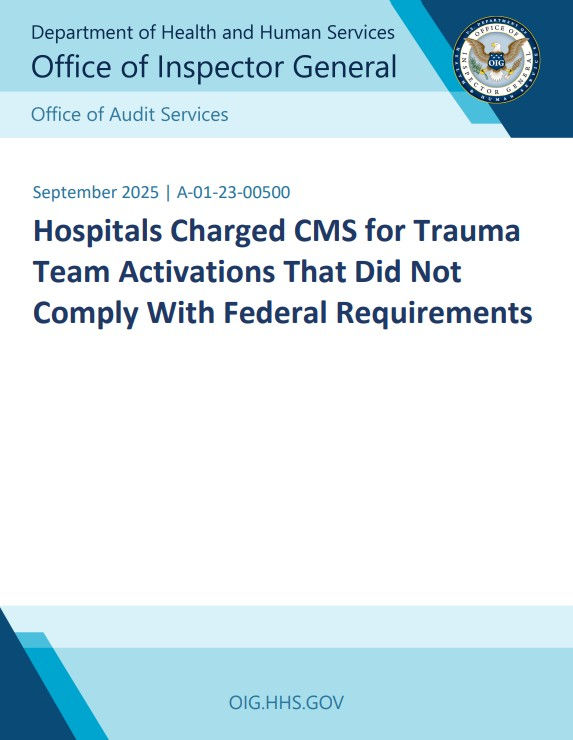
In September 2025, the Office of Inspector General (OIG) released a highly anticipated audit examining trauma team activation billing, specifically the use of revenue code 68X. The findings have immediate implications for trauma centers across the United States.
This is not just a compliance issue. It’s a credibility, financial, and operational issue that demands urgent attention.
What Is the 68X Trauma Charge?
Revenue code 68X represents the trauma team activation charge, designed to reimburse hospitals for trauma center readiness and rapid mobilization of specialized trauma teams. These charges are applicable for patients who meet the following conditions:
Hospital received pre-arrival notification
A qualified trauma team was activated based on pre-established criteria
The patient was met by the team with an immediate, organized response
The patient required and received medically necessary care
What Did the OIG Find?
The OIG audit revealed widespread noncompliance that signal systemic issues, not isolated mistakes.
77% of sampled trauma activation claims did not meet Medicare requirements
There were an estimated $2.4 billion in unallowable charges between 2020–2022
Criteria for use of 68x were not met, with common errors including:
Patient arrived with no pre-arrival notification
The trauma team was not activated appropriately
The activation lacked medical necessity
The activation happened after the patient arrived
How Could This Happen?
The root causes are varied:
Misunderstanding of CMS rules and when 68x can be used
Disconnect between clinical and billing teams at trauma centers
Pressures from ACS to manage over- and under-triage, specifically in the geriatric population
Weak documentation, especially regarding time stamps and activation triggers
What Should Trauma Centers Do Now?
The OIG report is not just retrospective - it’s predictive. Audits could follow and, at a minimum, compliance teams and payers may apply extra scrutiny to these charges in the future.
Here’s how trauma centers should respond:
Validate Your Hospital's Activation Policy
Your trauma activation policy must clearly specify the physiologic, anatomic, and/or mechanistic criteria for activation. The response should be tiered (full, partial, consult) and indicate who is required to respond and the response time requirements. It also must be consistently applied, with charge nurses having authority (without ED provider oversight) to call a trauma activation before the patient arrives at the hospital.
Align Clinical, Coding, and Compliance Teams
Create a Trauma Finance Committee that is responsible for documentation and chargemaster issues, as well as reviewing denials and ongoing monitoring. At a minimum, this group should include:
Trauma program leadership
Coding/billing experts
Compliance officers
Strengthen Documentation Standards and Ensure Discrete Data Points
Your hospital needs to ensure that data are recorded correctly and the required fields are discrete data points that can be pulled by billing and reporting databases. This includes: the time of notification from EMS, the time of the trauma activation, the time of the patient arrival, the trauma team members present for the activation and the time they arrived, and the clinical justification for the activation. Use of a standardized trauma flowsheet can dramatically improve clinical documentation.
Fix the Chargemaster and Billing Logic
Work closely with your HIM and billing teams to ensure the 68x charge is being applied correctly, that the appropriately fields are being utilized, that G0390 and critical care codes align with documentation, and non-qualifying cases (i.e., no prehospital notification, activation after patient arrival) use appropriate ED billing codes (450). Ensure the Type 5 Field Locator is also being triggered automatically in the system when an activation is called.
Audit Every 68X Charge and Compare Patient Lists to the Registry
Move from retrospective audits to prospective or concurrent review. This includes review of every 68x charge before it goes out, as well as reviewing the trauma registry patient list to ensure no charges were missed. High-performing centers track weekly compliance rates for 68X usage.
Prepare for External Scrutiny
The OIG explicitly recommended increased CMS oversight, more education, and potential recovery of improper payments. That could mean more audits, more denials, more payer challenges, and changing practices in payer negotiations. Get ahead of this scrutiny.
Hire a Consultant
If your hospital is struggling to figure this out or struggling to get the right people to the table, reach out to Diligent Consulting for support. We can provide the oversight, project management support, and guidance to systematically address and correct these issues at your hospital. For more information on finance-related service offerings, click here.
The Bigger Picture
The OIG report isn’t ideal, but it provides an opportunity for trauma centers to review, remediate, and improve their processes. Trauma activation fees exist because maintaining a 24/7-ready trauma team is expensive, but when billing practices drift away from clinical reality, the entire model comes under scrutiny.
The message from the OIG is clear:
Trauma activation billing must reflect real clinical need, real activation, and real documentation.
For trauma centers, this reports is an opportunity, not just to fix compliance gaps, but to build stronger, more aligned processes that support both patient care and financial integrity.